
Honen brings your knowledge, course creation, learner experience, and reporting into one connected platform. It is built by StudyFetch, Inc.
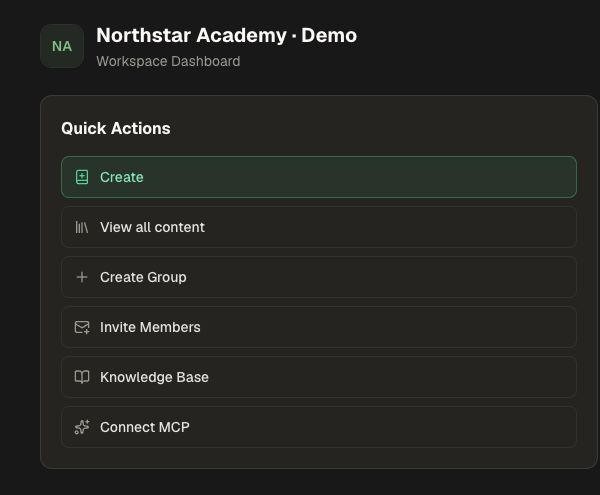
For a practical orientation, follow Find your way around Honen.
What Honen is
Honen turns source material into learning content, provides the learner experience, distributes that content, and measures the resulting work. It can serve as the organization’s own learning platform or deliver into an existing LMS.
The product has five connected layers:
- Knowledge: uploaded material and a shared Knowledge Base, including connected sources and document versions.
- Authoring: AI creates complete Courses, Assessments or Atoms from source material. The creation assistant collects setup decisions and proposes an outline for approval. After generation, authors inspect the working draft and learner preview, then request changes to supported lessons, activities, and assessments. Branding, Rules and Skills shape generation.
- Learning: readings, cards, quizzes, lectures, audio/video and applied projects, with a tutor alongside them. Curricula connect courses into programs. Keep sharp and Study banks extend practice.
- Delivery: share links and assignments for internal learners; public or sign-in-restricted Sites for external documentation, customers, and partners; and LTI, SCORM, or cmi5 for existing learning platforms. Workspace Agents bring approved knowledge and actions into messaging and embeds.
- Measurement: learner and cohort progress, scores and project review, curricula certificates, Agent run visibility, xAPI records, and workforce reporting.
See LMS integrations for delivery into an existing learning platform.
What a learner gets
A topic can offer several formats, with completion governed by the course or assignment requirements: read it, watch it, listen to it as a podcast, work through flashcards, read it as a comic, learn it as a song, play it as an arcade game, or answer quiz questions. The tutor can help alongside the activity. Two formats can run side by side.
The AI tutor provides voice or text help with tools matched to the current activity. Configure tutor guardrails and course settings for the guidance you want learners to receive. See the learner experience.
What an administrator gets
Three AI surfaces, each with its own job: the Course-Editor agent for content, the Workspace Assistant for operations and analytics in plain language, and the Widget Builder for custom reporting described in a sentence. See the three AI surfaces.
Use assignments to set required work for a whole course or selected units, topics, and activities. Organize teams in groups and subgroups, inspect cohort progress in Analytics, and prepare program evidence through Funder Reporting.
Who it is for
Individual learners, K-12 districts, higher education institutions, enterprises, small businesses, government agencies, workforce development programs, trades and unions, and assessment providers. Choose the sources, practice formats, and delivery settings that fit the program. See who Honen is for.
Reference documents
Core
Building and learning
Delivering and measuring
- Assignments
- Sites and distribution
- LMS integrations
- Analytics and reporting
- Funder and compliance reporting
Organization and platform
- People, groups and workspaces
- Knowledge base and parallel training
- Agents
- Integrations and MCP
- Security and compliance
Repeatable creation, review, and operations
Governance brings your authoring and approval standards together. Templates standardize Courses, Atoms, and Assessments with instructions, Skills, source folders, and optional structure. Publishing reviews compare a submitted version and collect the required approvals before catalog delivery. Automations run scoped Agents on schedules, by webhook, or manually, including proposals for human review. Analytics adds Monthly activity for content creation, first publications, learning starts, and completions.
Explore more
Find every tutorial in Explore the Honen guides, organized from getting started through authoring, learning, delivery, governance, administration, and integrations.