
Start with a job task and the evidence that would show someone can do it. Then build the learning path around that task. Use Honen's authoring, delivery, and reporting tools to teach that skill, give people practice, and review their progress.
1. Define the target skill
Write down the role, task, approved procedure, and observable success criteria. For a fictional support specialist:
Run a welcome call, confirm the customer's goal, locate an approved guide, and agree on a next step. Do not invent product behavior.
Keep your role-skills matrix in an approved document and attach the relevant requirements to the course. This gives authors a shared definition of the skill they are teaching.
2. Establish a baseline
Create an Assessment, or add a quiz, unit test, and realistic project to a course. Give the project clear criteria. For a welcome call, a Scenario can assess whether the learner asks the right questions and gives a source-backed answer.
Review the generated questions and rubric before assigning them. Record the baseline scope and criteria so that later comparisons mean something.
Choose a content type · Activity and project types
3. Build from your own expertise
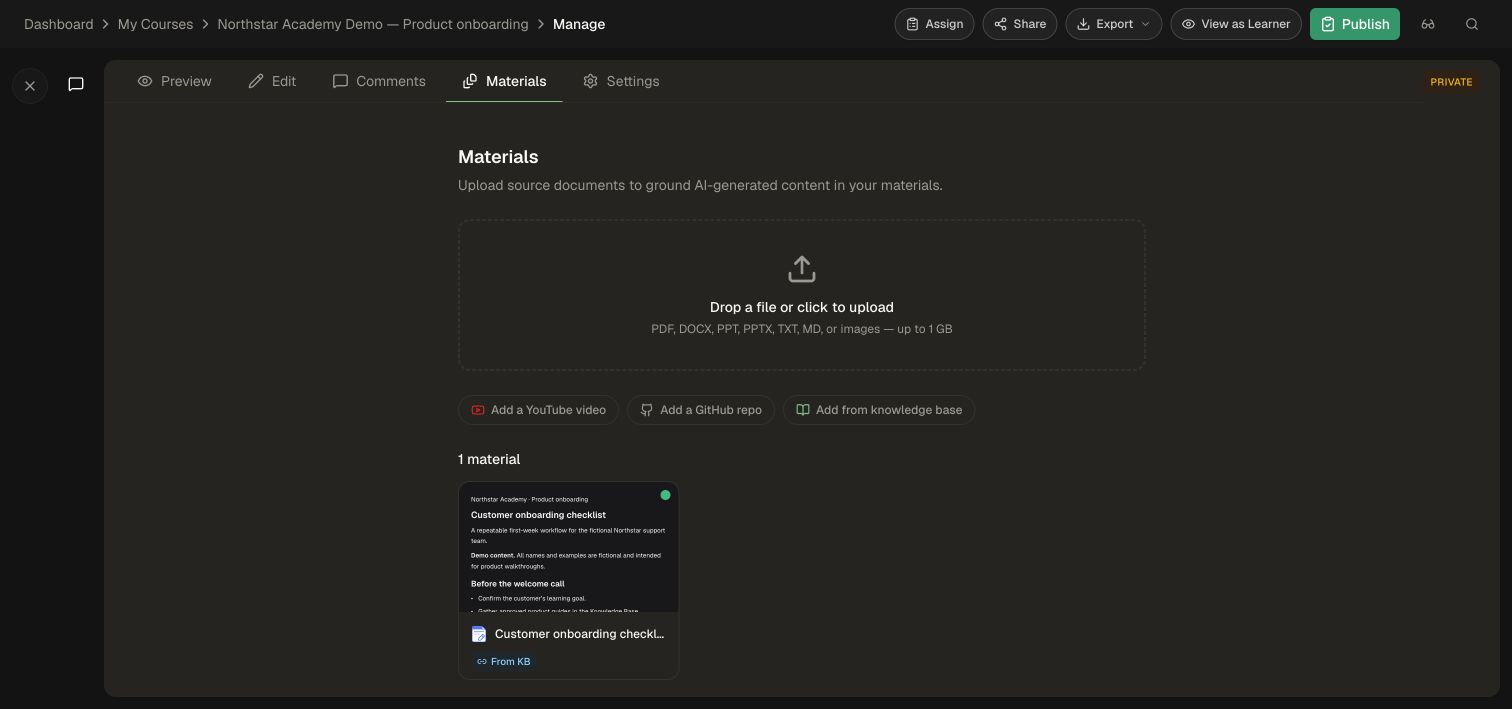
Import approved notes, manuals, or other sources into the Knowledge Base. Start a Course with the relevant material and target skill. Answer the creation assistant's setup questions, then review and approve the outline. After generation, inspect the lessons and practice in the editor.
4. Deliver a focused path
For a single task, assign the relevant topic or activity. For a longer role transition, build a curriculum with ordered courses and a certificate configuration. Assign it to the intended group with explicit test, project, score, and timing requirements.
Assignments · Learning paths and certificates
5. Review evidence and revisit it
Inspect assessment results, project submissions, and course analytics alongside completion. Compare equivalent tasks and rubrics rather than treating more time in the course as proof of greater ability. Use targeted follow-up practice for weak areas and Keep sharp or Study banks for later review.
Add a manager's observations, external exam results, and employment outcomes to your evaluation when those are part of the program. Collect or import these records alongside Honen's learning evidence.
Analytics · Retention and refreshers
6. Update the training when the work changes
Update the approved source and use Refresh from KB in the course's materials when a new version is available. Ask the Course Editor Assistant to revise the affected content, review the draft, and follow your catalog's publishing policy. See Maintain source-backed learning for the full update flow.
Related reading: Skills-gap measurement, reskilling and upskilling, completion and mastery, and training for new AI roles.